Interleaf
A cross-domain practice scheduler — which skill next, and for how long.
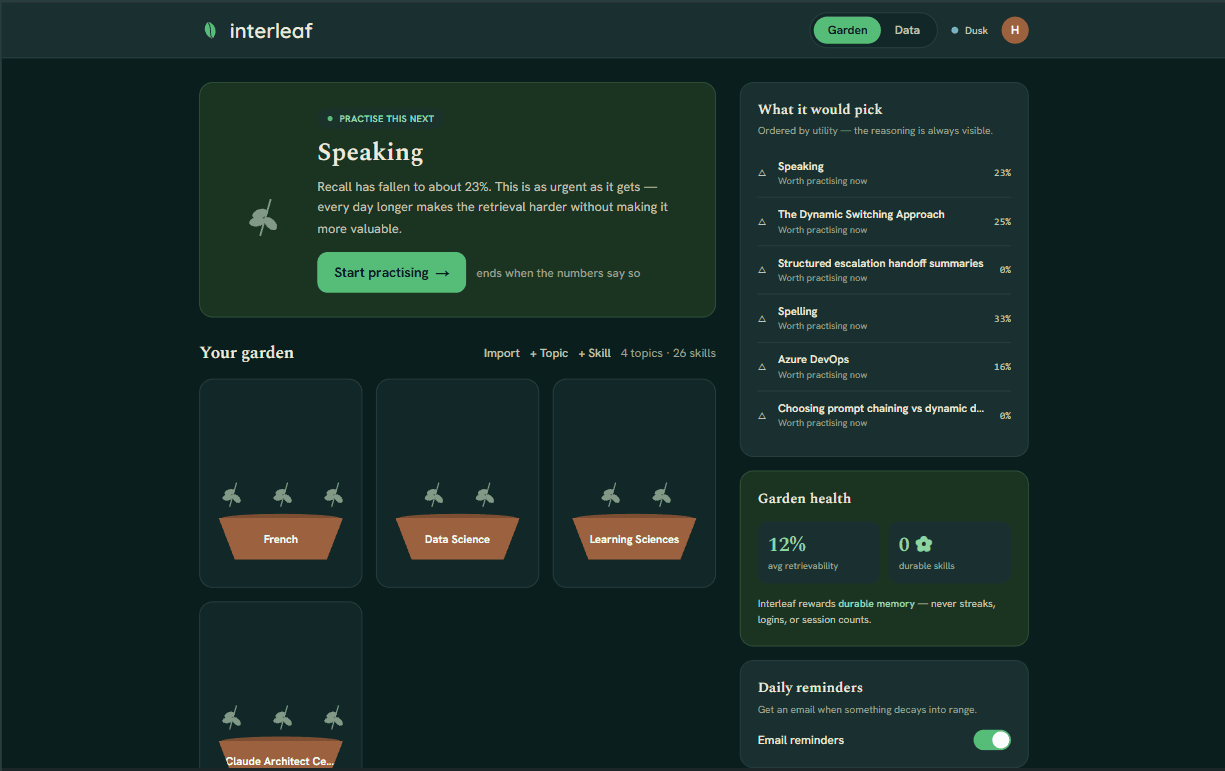
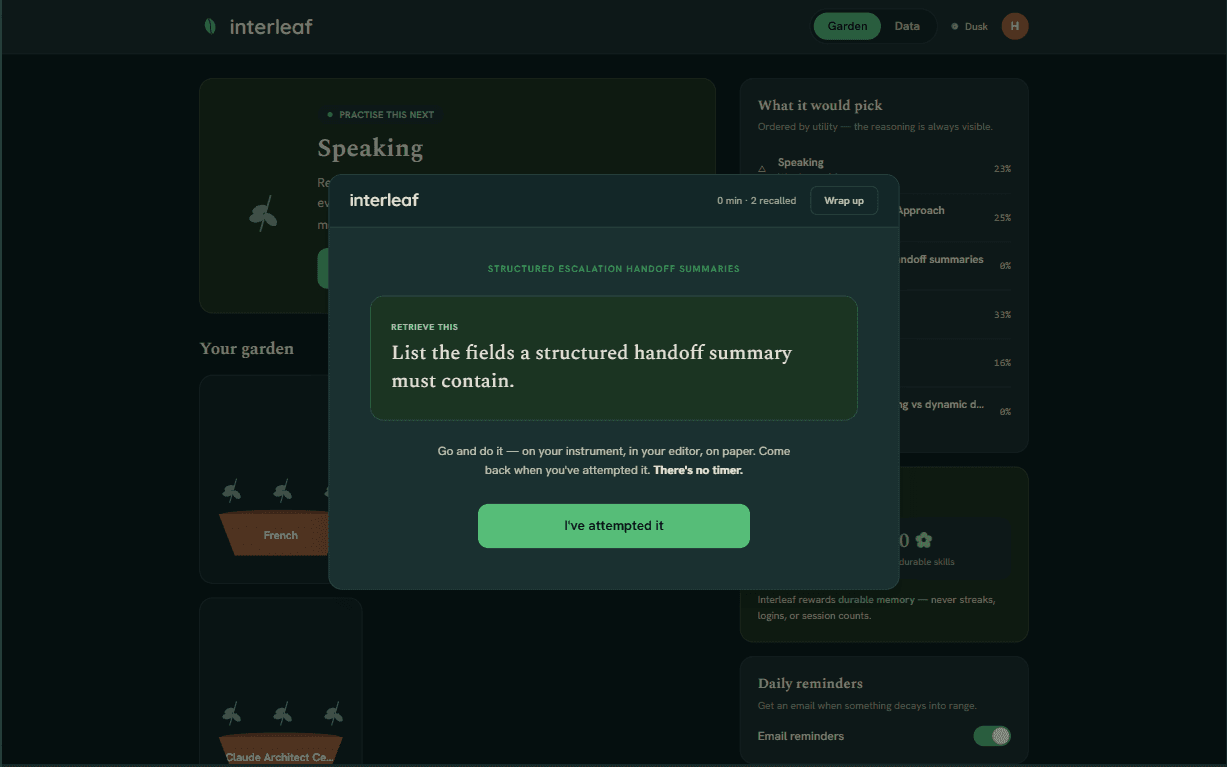
No tool decides which skill you should practice next.
People learning several unrelated skills at once — music, a language, programming — get plenty of help with when to review a card. Anki and FSRS solve that. Nothing decides which skill to open first, or when to stop.
The self-regulated-learning literature is blunt about why that matters: learners systematically mis-schedule themselves. We prefer blocked practice, and we trust the feeling of fluency over the evidence of retrieval. The scheduling decision itself is the unmet need.
Solo founder. I own the design end to end:
- —Model design — the utility-maximization loop, the saturating desirable-difficulty urgency curve, the four-channel cognitive-fatigue model, and the hysteresis-based switching policy that makes session length emergent.
- —Architecture & roadmap — a closed-form v1 with zero trained parameters, plus a data-gated path to a learned decay model (v2) and a cross-skill transfer GNN (v3).
- —Research grounding — a structured reading of the memory, interleaving, self-regulated-learning, and knowledge-tracing literature, used to separate validated mechanisms from novel ones.
Every tick, each skill gets a utility score combining four forces: urgency (is this skill in the effortful-but-recoverable “desirable difficulty” band?), fatigue (how loaded are the cognitive channels it draws on?), readiness (are its prerequisites mastered?), and interference (was something semantically adjacent just practiced?). A hard reachability mask excludes any skill with an unmet prerequisite.
Two decisions are deliberate. Urgency saturates rather than following a symmetric bell curve — an overdue skill stays at maximum urgency instead of being deprioritized forever, avoiding a death spiral for exactly the skills that most need rescue. And switching uses hysteresis, so the schedule doesn't thrash at every crossover and session length becomes emergent, controlled by one interpretable knob rather than a fixed timer.
v1 ships fully closed-form: zero trained parameters, perfect cold start by construction. Its one real obligation is the append-only logging spine, which becomes the training set for a learned decay model at around 5–10k reviews, and eventually a two-relation graph network that models cross-skill transfer — but only once it beats calibrated Half-Life Regression on a time-split evaluation. The log is the asset: training data, product analytics, and research corpus are the same table.
Interleaf is careful about what it claims. The classic interleaving effect — the one that makes shuffled practice beat blocked practice — depends on similar, confusable categories and does not transfer to unrelated domains (Brunmair & Richter, 2019). So Interleaf never claims that effect for cross-domain switching.
The cross-domain benefit is claimed instead via three distinct mechanisms: forced spacing, contextual-interference-style variability, and channel-level fatigue relief.
Components with no direct empirical validation — the four-channel fatigue model, the extrapolation of item-level decay to whole skills, and the size of any cross-domain transfer effect — are explicitly flagged as novel and instrumented for testing, not presented as settled science. Cross-domain transfer coefficients initialize at zero and must be discovered from real learner data before any transfer is asserted.
Interleaf is in early development (v1), so these are framed as intended outcomes rather than achieved results.
- —Multi-skill learners — a single answer to “what should I practice next?” across unrelated domains, replacing ad-hoc self-scheduling that the research shows is systematically biased, with session structure tuned by one interpretable parameter rather than rigid blocks.
- —Learning-science practice — an honest cross-domain design, plus a logging spine built from day one so novel components can be empirically tested rather than assumed.
- —The platform — a version sequence gated by data, not preference. Open-core intent: the algorithms and research are meant to be open, with a hosted service funding the infrastructure.